Fundraising myth #4: We need to recruit more millennials

Fundraising myth #4: We need to recruit more millennials
Donation behaviour is not determined by the generation someone belongs to, so what does influence it?
There is a deeply ingrained myth among fundraisers. We hear it at conferences, we read about it in fundraising plans, it is embedded in rebranding projects and proliferated by communication agencies.
“We need to find younger donors. Our older donors are dying. That is why we need to focus our efforts on millennials, as they are the future.”
For many charities, this myth determines their strategy. Although it appears to make sense at first glance, it is actually false.
The belief is based on assumptions, not on factual insights gleaned from data. When charities base their fundraising strategy on assumptions and gut feelings, they risk missing out on a lot of revenue.
What should you base your fundraising strategy on? Fundraising data will show you. A person’s donation behaviour is not determined by the generation they belong to. It is determined by the life phase they are in. That has always been the case.
The myth of generational differences
In the 1970s, older people (those born before 1940) were often critical of baby boomers. They commonly accused them of lacking respect, being spoiled and lazy and too self-centred.
Today, however, baby boomers are the most generous group of donors out of all generations.
Why is that?
People’s personalities haven’t changed, but their age and the life phase they are in have.
Studies show that our life phase and age affect our engagement, empathy and also donation behaviour. The latter is also partly attributable to the fact that older people generally have more disposable income.
Where does the myth come from?
We can identify three causes.
- Fundraisers and communication specialists tend to be young people. They find it tedious to focus too much on those boring older people.
- They also assume that the engagement and motivation of younger generations automatically translate to donations.
- In marketing and communication, there is a strong focus on generational marketing, yet that does not translate directly to fundraising.
We see that today’s young people are very engaged and willing to take action to build a better world. Yet they often lack the financial means to do so. Young people have to make financial choices every month, they have only just started their career and have high monthly mortgage payments to make. What little money they have left is spent on their personal development.
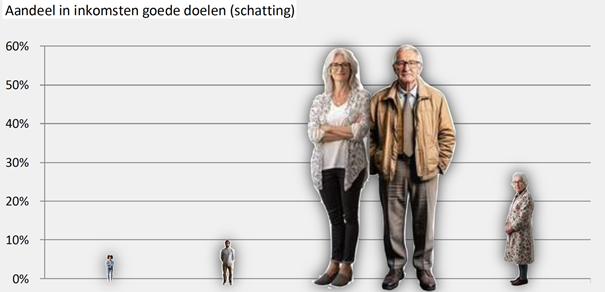
This is also reflected in fundraising data: young donors tend to make small, individual donations, compared to the frequent larger donations that older donors make for years on end.
The result
Every euro you invest in recruiting younger donors – who donate small amounts and often stop donating quickly – is one you cannot spend on strengthening your relationship with your older donors. Those older donors are the people with the financial means to donate larger amounts more often. In addition, they are easiest to inspire to leave you a legacy donation.
Note that this does not mean that young donors are unimportant. It means you ha
ve to carefully consider how you spend your
and what returns you can get on your investments. Take a look at this diagram illustrating the percentage of the total donation revenue that each age group is responsible for.


How to dispel this myth
As we’ve seen, your donor’s life phase determines the success of your fundraising, not the generation they belong to. Every life phase plays a role. Yet they do not all yield the same results. You should therefore think in life phases when determining your fundraising strategy and let your data dictate how you should spend your money.
- Young donors (supporters)
(usually up to the age of circa 35)
During this life phase, people tend to find out what is important to them and what they care about. Invest in engagement and small ways to build and strengthen your relationship. Although it will not lead to much donation revenue, it can mark the beginning of a fruitful relationship.
- Adult donors (future high-value donors)
(usually 35–55 years old)
During this phase, people mostly focus on their family, their career and their personal wealth. They have some disposable income. Invest in recruiting small structural donations. Although the donation revenue is still relatively low, you are laying the foundation for future high-value donations.
- Older donors (key donors)
(usually 55–75 years old)
For the vast majority of charities, this is the most important age group for their fundraising efforts. In this life phase, your donors:
- possess the most wealth
- make the largest donations
- show the strongest sense of engagement
- are most willing to make larger donations
- are considering the possibility of making a legacy donation
This is the group of donors you should devote most of your time, money and attention to.
- Elderly donors (potential legacy donors)
(75+)
During this life phase, people are thinking about their legacy. Some donors may stop donating, but that is not because they no longer care about your cause. Your focus must shift to:
- inspiring donors to leave you a legacy donation
- building personal relationships
- building trust
* Summary by Mark Phillips
What does this mean for your fundraising strategy?
Invest your money based on your donors’ life phase, not the generation they belong to. As is the case today, older donors will be the ones to generate the most revenue for your organisation in the future.
Develop a strategy that lets you:
- earn renown among younger target groups
- strengthen your relationship with middle-aged people
- invest the most money in donors with the largest donation capacity
- develop legacy donation programmes for elderly donors
Conclusion: your fundraising strategy should be based around your donors’ life phase
Too many charities, fundraisers and management focus too strongly on younger generations and not enough on the life phases that are financially most rewarding for their organisation. Generally speaking, older people can afford to donate more money than millennials. People’s donation behaviour has been surprisingly predictable for many years – and it always will be.
