Fundraising myth #3: “My donors are unique.”

Fundraising myth #3: “My donors are unique.”
Why your unique way of reaching out to donors is ineffective
Your donors are not like the donors of every other charity out there. That is why the demonstrably effective strategies that other charities use will not work on your donors. You have to reach out to your donors in your own unique way.
Right?
Wrong. Thinking like that is a mistake – one that can cost you a lot of money. Even though every donor is a unique individual, their behaviour when it comes to making donations is often remarkably predictable.
Where does the myth come from?
Charities work hard on their own organisation. They do amazing work to make the world a better place. It is therefore perfectly understandable that they are highly focused on everything they do. However, this can unintentionally lead to certain assumptions.
Keep reading if you believe the following assumptions are true.
- Charities often believe a donor gives them money because they want to support the charity’s mission and organisation.
- They believe the general rules of fundraising do not apply to their unique donors.
- They believe that their unique, specific approach will attract a unique type of donor.
Consequently, fundraisers believe that standardised data-driven formulas will not work for them.
The result?
Inefficient fundraising efforts.
We see that many charities that believe this myth tend to talk too much about their own unique approach. This leads to low donor engagement, because you do not offer them the things that are truly important to them.
The donor stops giving you money. Instead, they give their donations to an organisation that demonstrates that it knows what its donors want.
Understand your donors’ behaviour
The behaviour of donors is often remarkably predictable. Your donors are no exception. You need to be mindful of this when reaching out to your donors.
Successful organisations understand three core tenets:
- Donors do not support your organisation, but rather your mission because it coincides with their own
- A donor is not ‘your donor’; instead, you are one of your donor’s organisations.
- Most donor behaviour is driven by data, psychology and demonstrably successful strategies.
They are not one of your unique donors; you are one of many organisations they donate to
A while ago, a client asked us to reach out to its donors to thank them for their support. We asked them if they supported any other charities as well. One donor replied:
“Hold on, let me grab my list.”
They proceeded to list twenty charities they donate to.
That donor is far from the only one to keep a list.
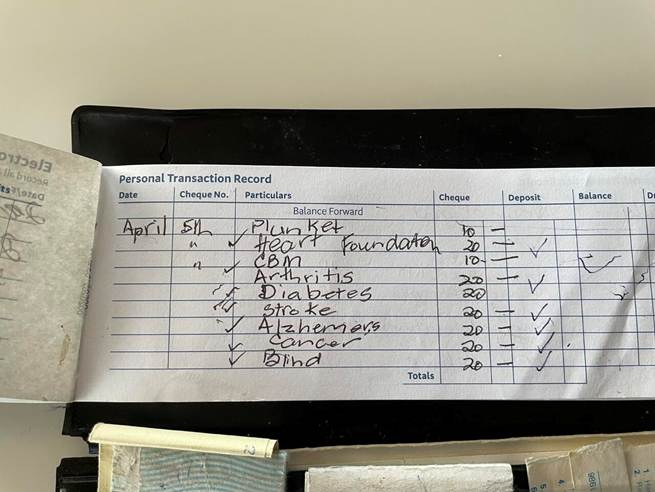
Sarah Lawson (Moceanic): “This is my aunt’s chequebook. The only thing she recorded in it were the donations she made to her chosen organisations. Donors choose their charities, not the other way around. I have held on to this book, because it reminds me of that important fact.”
When we share these images and quotes with fundraisers, they are often surprised. So many charities, and people track everything?
”Donors are amazing people,” Sarah said when we spoke with her about this topic. “My aunt’s chequebook lists twenty-one different charities. She lived alone and worked as a teacher. She didn’t have a lot of money, yet giving was so important to her. All these donations were made on the same day. I sometimes picture her sitting at her table, surrounded by the mailings she had saved. I see her going through everything and writing her cheques. I hope this made her feel really good and her letterbox was full of wonderful, heartfelt thank-you letters the following week.”
What do you actually know about your donor?
- Can you picture them?
- Why do they donate, what is important to them?
- How can you thank them for their donation?
How to dispel the myth
Once you realise that you are one of many charities to which your donor gives money, you will automatically begin to focus more on their wishes instead of your own.
You will employ best practices that put your donor first, such as the proven system of asking for a donation, thanking your donor and reporting back to them.
You will examine why donors do what they do, by listening to them instead of yourself.
Start by listening
- Listen to your data. Your data reveal what is important to your donors. What they want to donate to. What motivations they have in common. Do more of that and you will start to raise more money.
- Listen to your donors. Send out a survey and ask them why they donate and what is important to them. This tells you what you should focus on in your fundraising and communication.
You can then tailor your communication accordingly. This means you stop telling your donors what is important to you and start sharing what is important to them.
Your most important task as a fundraiser is to make your donors happy
Give your donors a chance to do good and contribute to a cause that is important to them. That will make them happy and motivate them to give more to your charity.
Need some help creating an effective donor engagement survey?
Contact benjamin.braun@mindwize.nl
Want to take your fundraising to the next level?
Follow the strategies in this whitepaper and growth will follow. This whitepaper contains eight strategies we’ve been using for over 30 years to help organisations like yours grow.
