

Fundraising myth #2: you should leave new donors alone
New donors actually want to hear from you (and that initial gift is not the most crucial)
Fundraising is expensive, so you are thrilled when your recruitment campaign brings in new donors. Yet if you do not treat these new donors well, that one donation is all you will get from them and you will not recoup your investment. On the contrary: you are in fact wasting money.
That first donation is wonderful, of course, but a donor who donates a second time shows you that their initial gift was not an impulsive action. That is why the second donation is even more important than the first. You also need to ask for it sooner than you might think.
“The Life Time Value of new donors who make a second donation within three months is twice as high as that of donors who donate again after three months.”
Where does the myth come from?
Many fundraisers believe you need to leave new donors alone for a while. They are worried about asking too much too soon. Yet by not communicating at all, you are unwittingly sending the wrong message: ‘Thank you. Noted. You will hear from us again when we need more money.’ That is not fundraising; it is a transaction.
When you ask donors why they stopped donating, three commonly heard answers are:
- I never got a ‘thank you’.
- I was never told what my donation was used for.
- I was never asked to donate again.
The result? Most new donors do not make a second donation
Sector-wide data show that only two out of ten donors who make an initial donation go on to donate a second time. The other eight donors disappear from the radar before a real relationship can be established.
If you leave too much time between a donor’s initial gift and your next communication, the new donor will simply forget about you and you will have wasted your chance to build a relationship with them.
That means you only earn back a small percentage of every euro you invest in the recruitment of new donors. It is therefore important to have a solid strategy to keep donors engaged.
Make new donors feel good
You do not need a complicated fundraising programme. Instead, you can start with these four steps, which are as simple as they are crucial. Let go of your own resistance.
What is stopping you asking donors for another donation soon after the first? That probably has to do with how you feel about it yourself. ‘I would want to be left alone and not be bothered.’ These are just gut feelings, unsubstantiated by data.
1. Quickly send a personal thank-you message (within 24 hours)
While their second donation marks the beginning of your relationship with your donor, you lay the foundation for this relationship immediately after their first donation. You can strengthen your relationship even before asking for another donation by quickly sending your donor a personal thank-you message and showing them what you can do with their support.
This significantly increases your chances of receiving that all-important second donation. When the time comes to ask for a second donation, you further strengthen your relationship with your donor.
2. Welcome your new donor and briefly and clearly illustrate the impact of their gift (within one month)
After your initial thank-you message, send your new donor a welcome message within one month. Explain how important the donor is to your charity and show them the difference they are making with their donation. You can also ask a brief question: ‘What motivated you to help us?’
3. Ask for a second donation before the emotion from the first donation ebbs away (within three months)
The period during which a new donor is susceptible to your second donation request is roughly three months. During that time, they will still retain some of the happiness they felt when they made their first donation (givers glow). Especially if you manage to touch them with your narrative once more. After those three months, your chances of receiving a second donation drop rapidly.
When you look at the five-year LTV (Life Time Value), you will see that donors who donate again within three months are the most valuable (study published by Analytical Ones).
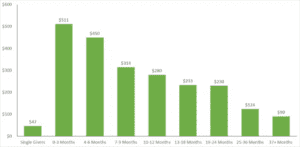
Donors who only donate once often cost you more than you get out of them. You can also see that donors who make a second donation within three months have by far the highest Life Time Value out of all newly recruited donors. So it is important that you give them a chance to do so.
You can also look at the data from EngageUSA. Its study also shows that the response rate to a second donation request is highest within the first thirty days.
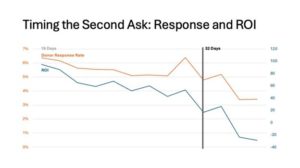
The most successful charities all have one thing in common: they reach out to their donors again soon after the first donation.
The most important result…
More new donors who make a second donation.
More donors who stay loyal to your organisation for longer.
Proof that it works
The proof is in the figures from Mindwize’s clients: quickly sending out thank-you messages, welcoming new donors and asking for another donation soon all lead to more second donations. The sooner you receive that second donation, the higher that donor’s Life Time Value will be.
Retention benchmark Retention Mindwize client

How to dispel this fundraising myth
Let the data convince you.
Recruiting new donors is expensive. You will only start to earn back your investment after receiving a second donation.
- Most initial donations do not cover your recruitment costs.
- You are more likely to recoup your investment with donors who make a second donation within three months of their first.
- After that second donation, a donor’s ROI and LTV shift from negative to positive.
Do not be afraid to ask for another donation or worry about communicating too often, because donors are happy to give. Your new donors want to feel that they matter, are important and are making a difference. They are eager to help out again and recapture that good feeling. Give them that opportunity.
So: thank new donors immediately and ask them for a second donation within three months
If you do that in an effective and personal manner, you will receive that second donation and can begin to build your relationship with loyal, valuable and committed donors. Together, you can make a lasting impact.
Want to take your fundraising to the next level?
Follow the strategies in this whitepaper and growth will follow. This whitepaper contains eight strategies we’ve been using for over 30 years to help organisations like yours grow.