Subscribe to our newsletter!
Would you like to receive regular tips and news on donor acquisition and retention? Subscribe now to our newsletter.



Direct mail is the driving force of every campaign. When you consider the ROI and donor retention, it is still the most effective fundraising method. However, you should not neglect your digital channels, as you can use those to increase your chance of receiving donations.
Organisations that combine online and offline channels:
Research by NextAfter shows that donors who interact with a charity both online and offline are three times as valuable and remain loyal for longer than donors who only donate offline. In other words: the more often you reach a potential donor with the same narrative, the higher the chance of them actually making a donation.
We call this integrated fundraising or a multi-channel campaign. You tell a single narrative via multiple channels. In our modern information age, charities need to use this approach to stand out.
You have developed a strong direct mail with a powerful narrative, a clear sense of urgency and an effective donation request. How can you effectively utilise that same narrative online?
You can tie your website into your direct mail in various ways.
2. Homepage header or banner
3. Pop-up or pop-in donation form
4. Donation page
Donors who receive communications via both regular mail and email tend to donate more and stay loyal to your organisation for longer.
There are several ways to link email to your direct mail:
In between the various direct mail moments, you can use social media to increase the visibility of your campaign. This makes your narrative more recognisable. For example:
With organic posts on social media, you will reach circa 10% of your followers. You can expand your reach with advertisements. Although you can use the same angles as for your organic content, you can also utilise additional segmentation and optimisation.
Display ads are ideal to:
Use the same visual language and copy as in your direct mail.
For KiKa, we developed a direct mail that focused on Céline’s story. It consisted of an envelop, a letter with a clear request for support and a brief message from Céline herself.
We translated the direct mail to email. For this, we used the same message and similar elements, albeit with a more compact and screen-friendly structure: a brief intro, the core of Céline’s story and a call-to-action button. The email was sent to a subset of recipients of the direct mail, leads and single donors.
This exposed the target group to the same narrative multiple times via different channels, which boosts both recognition and response.
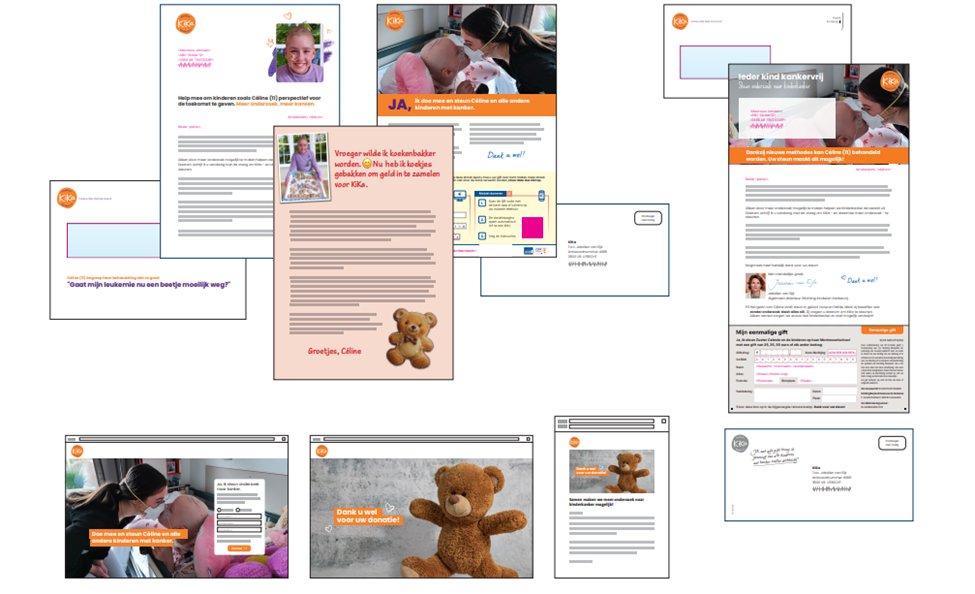
These narratives also formed the central thread in all digital Christmas communications.
Using online ad campaigns, we made sure that the target audience would recognise the direct mailings when they received them. The advertisements were exclusively shown in the top 200 postcode areas where the direct mails had been distributed.
People were exposed to the same pictures and narratives online as in the direct mailings. Every click led to a donation page with amounts that matched the donation request in the direct mails.
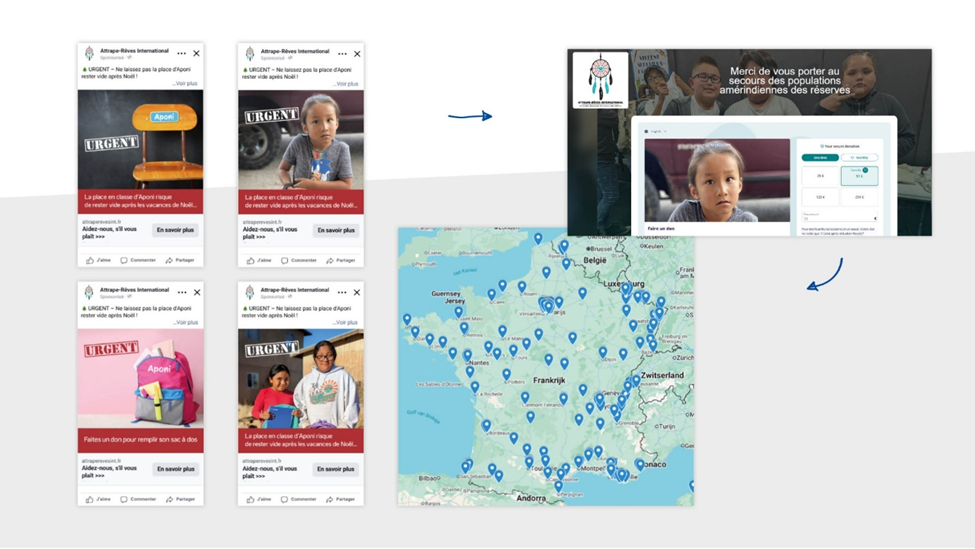
Integrated fundraising works, because it ties into how donors behave in this day and age. They move through different channels all day long. They scroll through their social media feeds, open their inbox and later find a letter on the doormat. By effectively combining direct mail and digital channels, you can increase recognition, foster trust and boost your response.
Would you like to learn more about what that might look like for you and what integrated fundraising can do for your organisation? Contact Benjamin Braun for an introductory meeting without any further obligation.
Would you like to receive regular tips and news on donor acquisition and retention? Subscribe now to our newsletter.