15 strategies to increase the average gift

The average gift is a key KPI in fundraising. And rightly so. A small increase in the average gift will immediately boost your total income. If you can inspire your donors to give a little more, your income will increase significantly and sustainably.
10,000 gifts a month × an extra €5 = €50,000 in additional income
Here are 15 ways to increase the average gift.
1. Ask for a specific amount
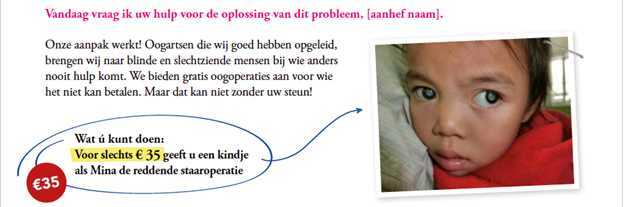
One of our clients provides eye surgery for children who are blind or at risk of going blind. They can provide this surgery for €35. This is a strong, tangible proposition. The donor understands the problem, knows the solution, and can see the impact of their gift.
The client has noticed that many donors who previously gave smaller amounts are increasing their gifts towards €35.
2. Use a gift ladder
At Mindwize, we often use a gift ladder. Donors can choose from three giving options.
Why three? Research in neuroscience suggests that many donors instinctively opt for the second, middle option. This is known as the compromise effect or default effect.
Let’s say someone’s last gift was €24. Make the second option slightly higher, for example €29. This can encourage donors to give more.

In our example, the gift ladder would look like this: 24 – 29 – 39.
3. Use an open text field
AlsIf you want to offer more than 3 options, be aware that this does not always lead to better decisions for the donor. For example, offering 5 options can cause the choice overload effect. The donor can experience choice overload.
You could take a different approach:
- offer 2 or 3 options instead of 5
- Combine these with an open text field
The result is less distraction, less choice overload for the donor, and more focus on higher gift amounts. The donor is more likely to feel satisfied with their choice.
4. Use the middle amount wisely (the decoy effect)
In neuromarketing, there is a concept known as the decoy effect. It involves adding a middle option that makes the third option more appealing.
How does it work?
Let’s say you offer two gift amounts: €15 and €60. For many donors, the gap between these two options may be too wide. They may therefore be more likely to choose €15. Add a middle option that is closer to the higher amount than the lower amount, such as €57.
The €60 option may suddenly look more appealing: 15 – 57 – 60.
5. Bring the amounts closer together
A large gap between gift amounts can put donors off. By narrowing the gaps, you can encourage donors to give a little more.
Let’s say this is your gift ladder:
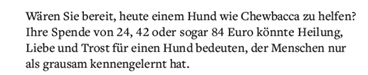
A very different strategy is to add an extremely high option. This changes how donors perceive the other amounts. If you opt for this strategy, offering more than three options can actually work well.
For example, €150 may seem like a high amount:
€30 – €50 – €75 – €150
But if you add an even higher amount, €150 no longer seems quite so high:
€30 – €50 – €75 – €150 – €2,500
Donors may then think: If €2,500 is an option, then €75 or €100 may seem quite reasonable.
This is a proven psychological principle known as priming.
7. Mention the total amount you need (another priming strategy)
Mention the total amount you need in your text just before you ask for a gift. This makes the individual gift amounts you are asking for seem smaller. What’s more, there is always a chance that one donor might give the full amount. We have seen this happen with our clients several times.
Let’s say you need to replace a digital whiteboard costing €7,000. You could phrase it like this:
‘Do you know what it costs? It costs €7,000 to replace the digital whiteboard.’
Further on, you show the gift ladder as you normally would. And you never know, a €7,000 gift might be on its way.
That’s what happened with one of our clients.

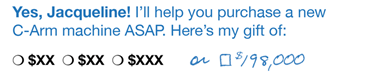
Another option is to include the total amount in the gift ladder, as in this example from Agents of Good.
8. Always a good idea: link amounts to something specific or tangible
We find that many fundraising organisations tell a story and then ask for a gift without linking it to anything specific or tangible. However, donors don’t simply give money. They give to something they can picture or touch.
Look at the difference:
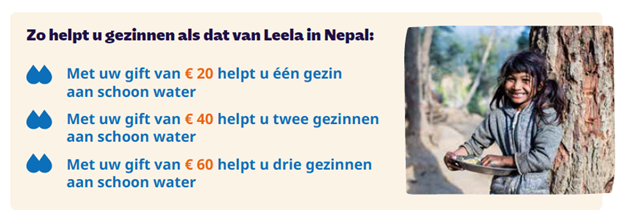
- €20 gift
- €20 = clean water for one family
9. Choose one specific or tangible focus for each campaign
We also regularly see campaigns featuring a well-designed gift ladder that is tailored to the donor and linked to something specific or tangible, but where each amount is linked to something different.
An example:
- €25 = one hygiene pack for a family
- €50 = ten meals for ten people
- €100 = access to education for one child
But what if your donor is willing to give, really values education, and can currently afford to give €25? Your donor may face a dilemma, which is another form of choice overload.
As such, you should ensure that each campaign focuses on a single specific focus with its own gift ladder.
- €25 for one day of education for one child
- €50 for two days of education for one child
- €100 for one week of education for one child
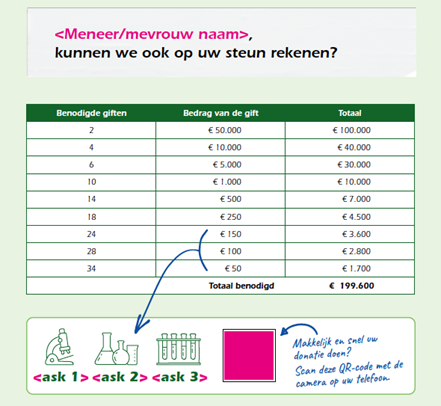
10. Highlight an amount
You can make the amount you want to encourage donors to give stand out. You could put it in bold, circle it or point to it with an arrow.
By drawing extra attention to a particular amount, you can encourage people to give around that amount. Of course, the amount you highlight depends on the donor’s giving behaviour.
This is how we tackled it for one of our clients:
11. Leave out the euro symbol
As soon as people see a euro symbol, they think about money they have to spend. This is known as the pain of paying.
Leaving out the euro symbol eases this pain. So instead of €50, use 50 euros.
Many restaurants use this principle and omit the euro symbols from their menus. Just look out for this the next time you go out for a meal.
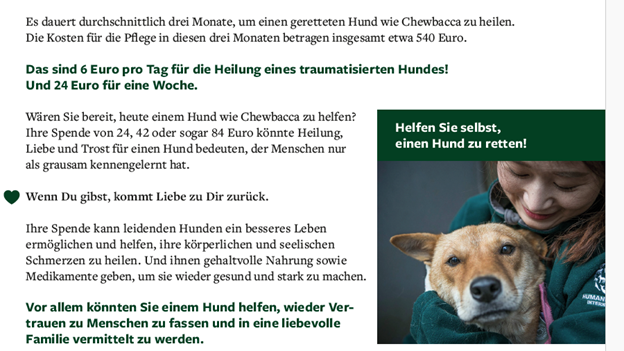
12. Show what others are giving (social proof)
Almost all of us tend to look to others when deciding what the right choice is. When you show what others are giving, people are more likely to give the same amount.
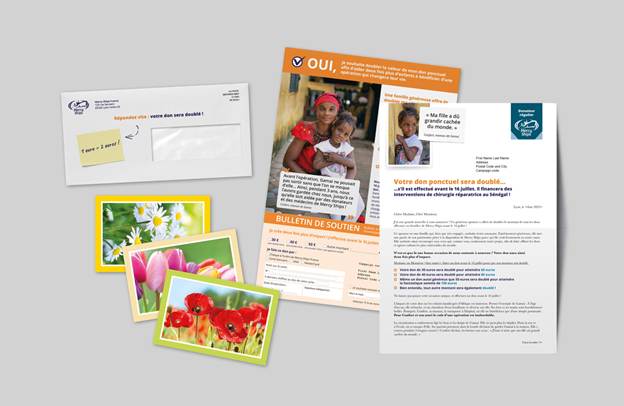
13. Use a matching gift
A matching gift enables a company or (anonymous) person to double a donor’s gift. You can then tell your donor:
- Your gift is worth twice as much
- You are helping twice as many children
For one of our clients, the average gift from this type of campaign was 50% higher than the average gift from other campaigns.
14. Invest in major donors
Major donors require a fundamentally different approach from regular donors. They expect a bespoke approach, personal attention and a relationship-driven strategy.
Standard tactics, such as pre-filled gift amounts, often do not work here. Organisations that treat their major donors in the same way as their wider supporter base are consistently failing to realise their potential.
An effective approach includes:
- Identifying high-value prospects
- Personalised journeys and communication
- Data-driven qualification and follow-up
The result:
- More large gifts
- Higher average gift amounts
- Structural growth of your average gift
- A stable group of donors who want to give more
We run separate campaigns targeting high-value donors for our clients, with a high degree of personalisation and higher suggested gift values.
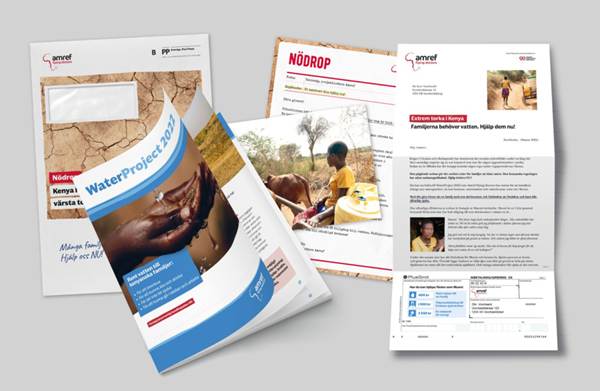
15. Segment and personalise
Not every donor is the same. Yet they are often treated as if they are. This is a missed opportunity, as some donors are able and willing to give more. By segmenting your database effectively, you can tailor gift amounts to behaviour and donor value.
The following segments might be useful:
- Monthly donors giving up to €75 and donors giving more than €75
- High-frequency donors
- Loyal donors (5+ years)
For each segment, you can:
- Show more relevant gift amounts
- Match gift amounts more effectively
- Achieve a higher conversion rate
This does require a little more preparation, but the results can be significant. If you do this consistently, you will find that donors move to a higher level of giving.
For this client, we used the ‘most recent gift’ as the basis for creating a gift ladder:

Test one strategy at a time and learn
Select one strategy and test it against your current approach. It is important to run the test across several campaigns so that you can analyse the results properly. Is there a clear winner? Then see whether you can optimise it further by testing another strategy.
Would you like a quick review of the fundraising appeal in your most recent mailing?
Book a free call

